
Our APA Survey Results
 Over the last year, the staff at the OWL conducted a survey to assess the effectiveness of our APA section. We received over 2,000 responses to our short questionnaire. Thank you to everyone who took the time to respond!
We’d like to share some of our results below:
Overall, the information on the OWL helped me understand the requirements of APA Style.
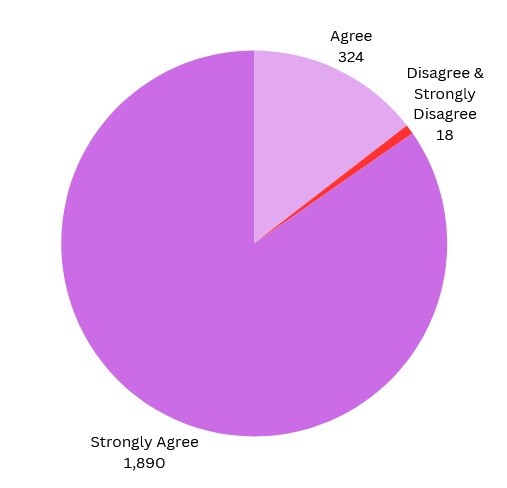
We were obviously pleased with this overwhelmingly positive result. (This also disproves the theory held by one of the OWL’s editors that people only take online surveys to complain!) Our APA section is the site’s most frequently visited, so it’s reassuring to know that we’re helping our users.
What specifically brings users to our APA section? We asked, and users answered:
I came to the OWL looking for information on:
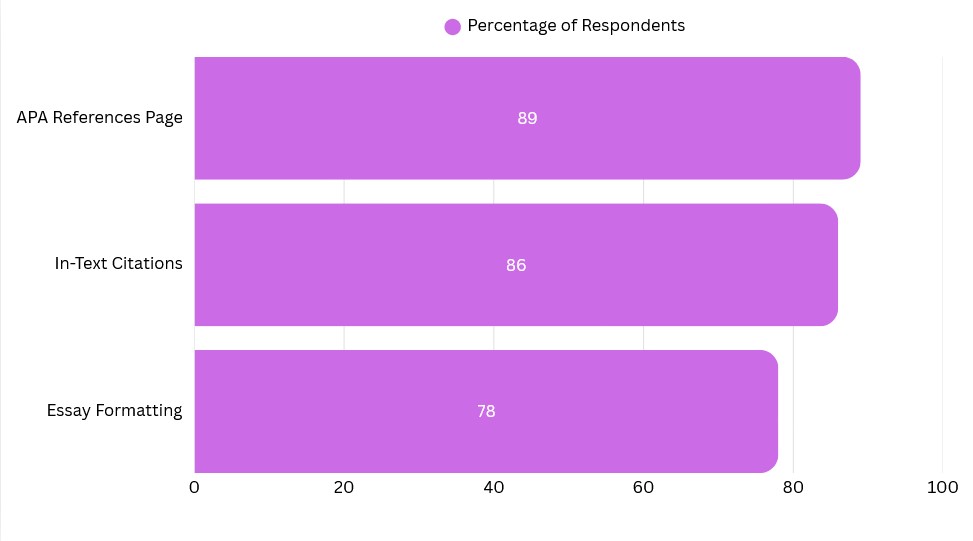
Most respondents selected the ‘all-of-the-above’ option. We aren’t really surprised that students have fewer questions about essay formatting and more about the nitpicky realm of citations and references.
Now, did our survey takers find what they were looking for?
I found the information that I was looking for:
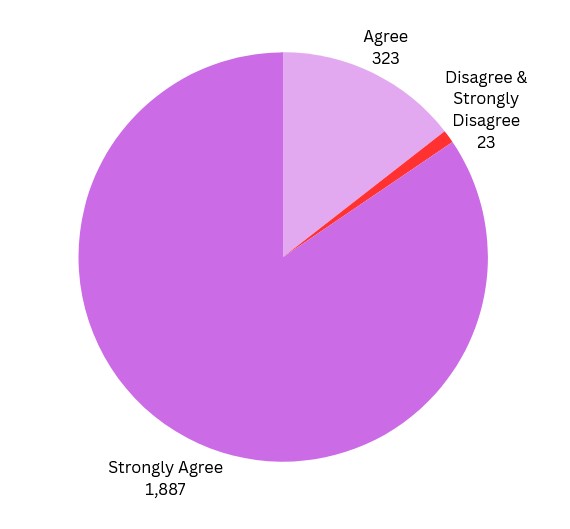
As expected, these results closely mirrored the overall satisfaction results.
However, these encouraging results don’t mean that our users didn’t have questions and suggestions about our APA material. We asked: What questions about APA material do you still have?
We received over 600 written responses to this question, and we read all of them. Now, this wasn’t as daunting of a task as it might sound. About half of respondents wrote to tell us that they didn’t have any questions.
“I don’t really have any major questions left about APA Style right now. Using the OWL was actually really helpful, it explained things clearly and made APA feel a lot less confusing than I expected.”
“IT’S HARD TO USE BUT ONCE I GOT IT I GOT IT”
“I really really really appreciate the formatting guide always check it before I turn in a paper super helpful.”
We’re always happy to learn that our formatting guide is being used. Check that out here.
The most common questions we received were variations of: “Why do I have to do this?” A representative example:
“The citations should not be as important as the information and the learning we are doing. I think that it is silly to care so much about perfection in source citing.”
We feel the same! A missed parentheses or a failure to italicize in a citation should never weigh as heavily on a grade as the content of an essay—even the most militant APA sticklers would tend to agree. So, why do we bother with all the rules and intricacies of APA? One of our respondents wrote us an insightful note on their experience with APA that we think answers the question for us:
“I’ve worked with APA Style quite a bit, and honestly, it’s one of those systems that feels intimidating at first but becomes surprisingly intuitive once you get into its rhythm. What I appreciate most is how it tries to make academic writing feel clean, consistent, and readable. When it’s used well, the reader never has to wonder where information came from or how the argument is structured. Everything flows.
The emphasis on clear headings, logical structure, and straightforward language makes papers easier to follow. It’s like giving your ideas a well-organized home.”
We couldn’t have said it better!
How about a lightning round of other common questions?
“Do I have to do this [specific thing] my professor asked for even though it’s not an APA rule?” (e.g. cite specific paragraphs, use 6th edition APA instead of 7th, double-spacing sentences)
While it might seem frustrating to learn all these APA rules only for your instructors to disregard certain ones, that just goes to show that APA isn’t as restrictive as it seems. It’s typically understood that instructor preferences trump what’s in a style guide.
“Why do we use DOI instead of URLs?”
URLs can change when websites are restructured. DOI numbers are more stable.
“What is the right number of sources per essay? Per paragraph? When do I use author-date format vs a narrative citation?”
Students want cut-and-dry answers to these questions, but they don’t really exist. Your paper needs as many sources as it takes to show how you arrived at your conclusion. Your citation format depends entirely on the flow of your writing and whether you’re quoting directly or not. You will learn to answer these questions intuitively the more that you write.
We received a lot of requests for examples of how to format specific types of sources. The Excelsior OWL is always open for requests, so we’ve expanded our coverage of the following items based on user feedback:
- More guidance for social media can be found here.
- Court rulings can be found here.
- How to cite websites with no authors can be found here.
- Expanded coverage of direct quotes to include material like podcasts, TV shows, and social media.
- Plus, a new page walking through the process of devising a direct quote citation for written material with no page numbers (like this very blog). This includes guidance on sources accessed via Kindle or other devices.
- More guidance on artwork and photographs, including how to cite photographs taken by the author. (Spoiler: you don’t.)
Besides citations, we’ve also expanded our formatting guides based on user feedback.
- Tutorials for things like block quotes and running headers can be found here. (These aren’t specific to APA, but they came up a lot in our survey.)
- Formatting for figures like charts, graphs, and images can be found here.
Our APA survey might be closed, but the OWL is always open for feedback. We love to hear from our users and we’re always eager to expand the site.
Okay, one final survey response:
“My assignment is not finished, and the time is up. Can I get an extension for today? It won’t happen again.”
Well, we can’t help with that. But if you’d like to see something about APA (or anything else) covered on the OWL, get in touch!
